
What is an MCP server, and why does every AI tool want one?
MCP turns 'connect the AI to our systems' from a custom project into a configuration step.
What is an MCP server? The short answer
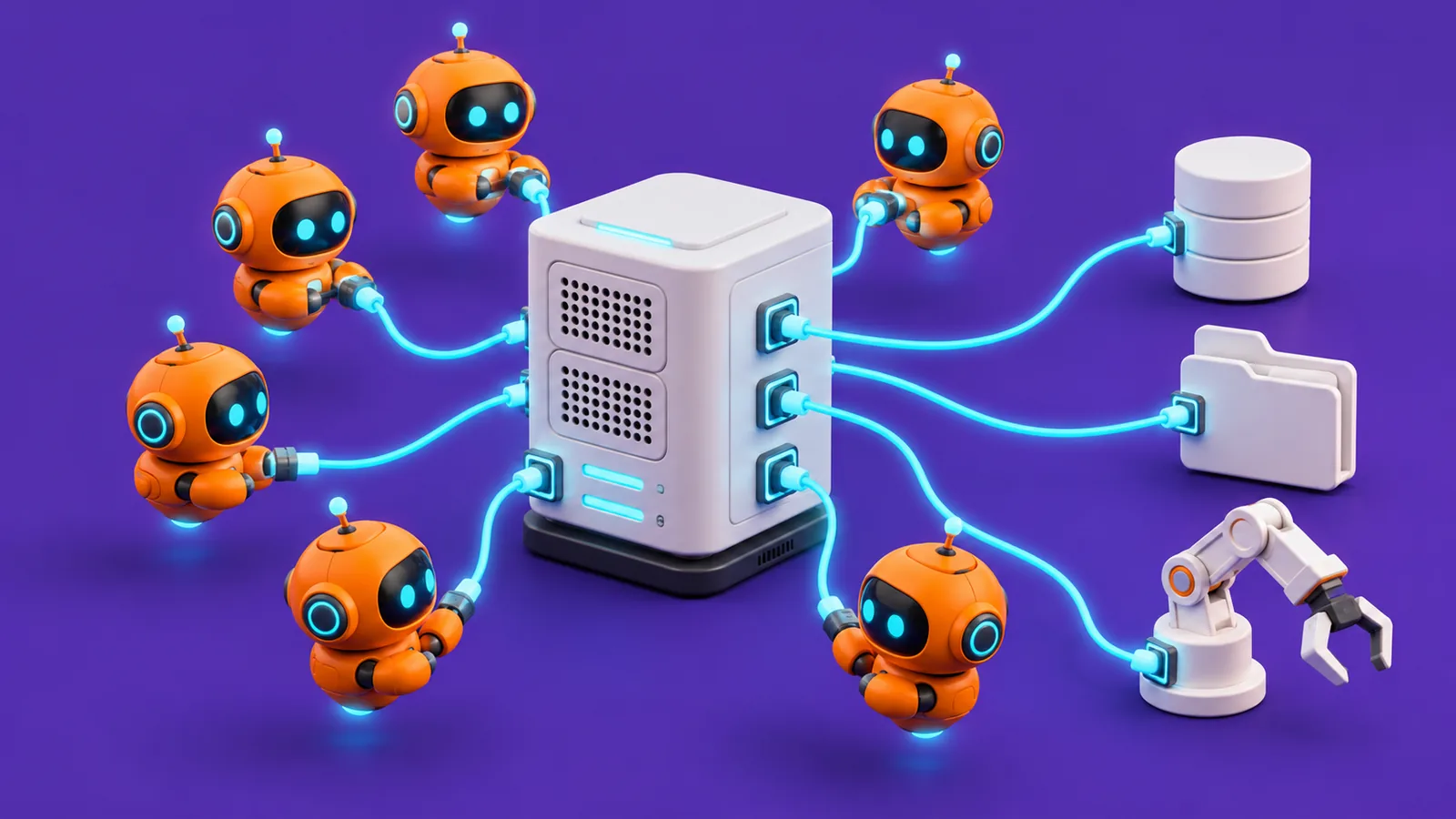
An MCP server is a connector between an AI application and a system it needs to use. It sits next to a system (a CRM, a database, a file store, an internal API) and describes, in a standard format, what an AI application is allowed to read and do there. The AI application, called the MCP client, discovers those capabilities and uses them when a task needs them.
MCP stands for Model Context Protocol. It is an open standard that Anthropic introduced in November 2024 and donated to the Linux Foundation in December 2025. Today it is supported by Claude, ChatGPT, Cursor, VS Code with GitHub Copilot and most AI coding tools.
MCP in simple terms
Think of MCP as a USB-C port for AI. Before USB-C, every device needed its own cable. Before MCP, every AI tool needed its own custom integration for every system it touched.
With MCP, a system gets one "port" (the MCP server), and any AI application that speaks the protocol can plug into it. The AI does not need to know how your database or ticketing system works internally. It only needs to read the server's list of available tools and call the right one.
What problem the Model Context Protocol solves
Large language models are smart but isolated. On their own they cannot see your files, query your data sources or perform actions in your software. Every time a company wanted an AI assistant to work with a real system, a developer had to write integration code for that specific pairing.
That does not scale. Ten AI tools and ten business systems meant up to a hundred custom connectors, each with its own API keys, error handling and maintenance. The Model Context Protocol replaces that with one interface: build a server once, and every MCP client can use it. Ten tools and ten systems now need ten servers, not a hundred integrations.
It also helps answers. When an AI can pull relevant information straight from the source system instead of guessing, it has fewer reasons to make things up.
How MCP works
MCP architecture: host, client and server
MCP architecture has three components:
| Component | What it is | Example |
|---|---|---|
| MCP host | The AI application the user works in | Claude, ChatGPT, Cursor, VS Code |
| MCP client | The connector inside the host that talks to one server | One client per connected server |
| MCP server | The program that exposes a system's data and actions | A GitHub, database or file system server |
People often use "client" and "host" interchangeably. Strictly, the host is the app, and it runs one client for each server it connects to.
What happens during a tool call
Here is the flow when you ask an AI assistant to "find last week's failed payments and open a ticket for each":
- Discovery. The client asks each connected server what it offers. The servers reply with their available tools and short tool descriptions.
- Planning. The model reads your request and the tool descriptions, then decides which tools to call. Here: a payments query tool and a ticket creation tool.
- Tool invocation. The client sends the tool calls to the right servers with the parameters the model chose.
- Execution. Each server runs the action against its system (an API call, a database query, a file read) and returns the output.
- Final response. The model reads the results and writes the final response, or makes more tool calls if the task needs them.
Under the hood, every message is a JSON-RPC 2.0 request or response. So yes, MCP is JSON, but with a strict, standardized format both sides agree on.
Local vs remote MCP servers
An MCP server can run in two places:
- Local. The server runs on your machine as a small process, and the client talks to it directly. Common in development environments, for example giving a coding agent access to your project files.
- Remote. The server runs on the web and the client connects over HTTP, usually with OAuth sign-in. This is how most company tools (CRMs, project management, payments) offer MCP today.
The current version of the spec, released on July 28, 2026, made the protocol stateless: each request carries its own context, so remote servers can scale like normal web services without sticky sessions.
What an MCP server exposes
Every MCP server offers up to three building blocks:
| Building block | What it is | Example |
|---|---|---|
| Tools | Actions the AI can call | Create a ticket, run a query, send a message |
| Resources | Data the AI can read for context | A document, a table, a log file |
| Prompts | Reusable instruction templates | A standard weekly report, a code review checklist |
Tools are what most people mean when they talk about MCP. They let the AI perform actions, not just read.
MCP server examples
Almost every category of software now has MCP servers, official or community-built. Typical examples:
- Code and development: GitHub or GitLab servers that let an agent read repos, open issues and review pull requests.
- Databases: Postgres, MySQL or data warehouse servers that let the AI query data in plain language.
- Files and content repositories: file system, Google Drive or Notion servers for reading and writing documents.
- Communication: Slack or email servers for searching and sending messages.
- Design: servers that give coding agents access to design files, so they can build from the real spec.
- Business systems: CRM, payments, analytics and ticketing servers.
MCP client configuration
Adding a server to a client is usually a few lines of configuration. In Claude Desktop, for example, a local file system server looks like this:
{
  "mcpServers": {
    "filesystem": {
      "command": "npx",
      "args": ["-y", "@modelcontextprotocol/server-filesystem", "/Users/me/Documents"]
    }
  }
}
Remote servers are even simpler in apps that support connectors: paste the server URL and sign in.
Which MCP clients support MCP?
As of late 2026, support looks like this:
| Client | MCP support |
|---|---|
| Claude (desktop, web) and Claude Code | Native, local and remote servers |
| ChatGPT | Apps built on MCP, plus custom servers via Developer Mode |
| Cursor, Windsurf, Zed | Native, a core feature |
| VS Code with GitHub Copilot | Native in agent mode |
| OpenAI Codex, Gemini CLI | Native for developers |
| Gemini app, consumer Microsoft Copilot | Limited; mainly through developer and enterprise paths |
The protocol is model-agnostic. The same MCP server works with Claude, GPT or Gemini models, which is the point.
MCP vs API: what is the difference?
MCP does not replace APIs. Most MCP servers call an API under the hood. The difference is who the interface is designed for.
| API | MCP server | |
|---|---|---|
| Built for | Developers writing code | AI models deciding at runtime |
| Discovery | Read the documentation | The client asks the server what it can do |
| Integration | Custom code per app | One standard every MCP client understands |
| Descriptions | For humans | Written for the model to read |
| Typical use | Any software talking to any service | AI agents using tools and data |
So is MCP just a fancy API? Partly. It is a standard wrapper that makes an API usable by any AI agent without custom code. Think of it as a universal adapter, not a new kind of plumbing. It is also not an API gateway: a gateway routes and secures traffic, while MCP defines what the AI can discover and call.
MCP vs RAG
Retrieval-augmented generation (RAG) pulls relevant documents into the model's context before it answers. MCP is broader: it can read data like RAG does, but it can also perform actions and query live systems. Many AI applications use both, RAG for a large knowledge base and MCP for tools and real-time data.
What it means for a business
- Integration cost drops. One server can serve every AI assistant your team uses.
- Control stays with you. The server decides what is exposed, so permissions live in one place.
- Vendor lock-in weakens. Switching AI tools no longer means rebuilding integrations.
- Agents become useful. AI agents are only as good as what they can reach. MCP is how they reach your real systems.
MCP security: what to watch
The security model matters more than the plumbing. An MCP server gives an AI system real access to real systems and sensitive data. The main risks:
- Tool poisoning. A malicious server hides instructions in its tool descriptions. The model reads those descriptions as trusted context and may follow them. Invariant Labs first documented this attack in April 2025.
- Prompt injection through results. A tool returns a web page, email or support ticket that contains instructions, and the agent treats them as commands.
- Over-scoped credentials. A server holding API keys or tokens with more access than the task needs.
- Supply chain. Installing a community server is installing someone else's code.
Security teams now have a shared checklist, the OWASP MCP Top 10, and the 2026-07-28 spec tightened authorization to match how OAuth is used in production. In practice:
- Install servers only from sources you trust, and pin versions.
- Scope permissions narrowly. Read-only unless writing is the job.
- Require human confirmation for actions that change or delete data.
- Log every tool call so you can see what the AI did.
- Treat every tool result as untrusted input.
Who controls MCP?
Anthropic created MCP, but it no longer owns it. On December 9, 2025, Anthropic donated the protocol to the Agentic AI Foundation, a fund under the Linux Foundation, alongside OpenAI's AGENTS.md and Block's goose. Google, Microsoft, AWS, Cloudflare and Bloomberg back the foundation. That neutral home is a big reason competitors now adopt it.
Do you need an MCP server?
- You use AI tools and want them to reach your systems: you probably need to connect existing MCP servers, not build one. Most popular SaaS tools already offer one.
- You sell software: yes, consider building one. Customers increasingly expect their AI assistant to work with your product.
- You have internal systems: a small internal MCP server can give every AI tool your team uses safe, logged access to them.
MCP itself is free and open source. Some vendors charge for their hosted MCP servers or include them only in higher plans.
FAQ
What does MCP stand for?
Model Context Protocol. (Not to be confused with Microsoft Certified Professional, the older certification with the same initials.)
What is Model Context Protocol in simple terms?
A standard way for AI applications to connect to external tools and data, so one integration works with every compatible AI tool.
Is an MCP server a real server?
Not necessarily a machine. It is a program. It can run locally on your laptop as a small process, or remotely on the web like any other service.
What is an example of an MCP server?
A GitHub server that lets an AI agent read code and open issues, a database server that lets it query data, or a file system server that lets it read and write documents.
What is the difference between an MCP client and a host?
The host is the AI application (Claude, ChatGPT, Cursor). The client is the connector inside it that maintains the connection to one MCP server.
Does ChatGPT use MCP?
Yes. Apps in ChatGPT are built on MCP, and ChatGPT's Developer Mode lets you add custom MCP servers.
Is MCP going to replace APIs?
No. MCP servers usually sit on top of APIs. MCP standardizes how AI applications discover and call them.
Is MCP secure?
The protocol supports authentication and access control, but security depends on the servers you install and the permissions you grant. Tool poisoning and prompt injection are the main risks.
Is Model Context Protocol outdated?
No. It is actively developed under the Linux Foundation. The latest spec version shipped on July 28, 2026, the largest revision since launch.